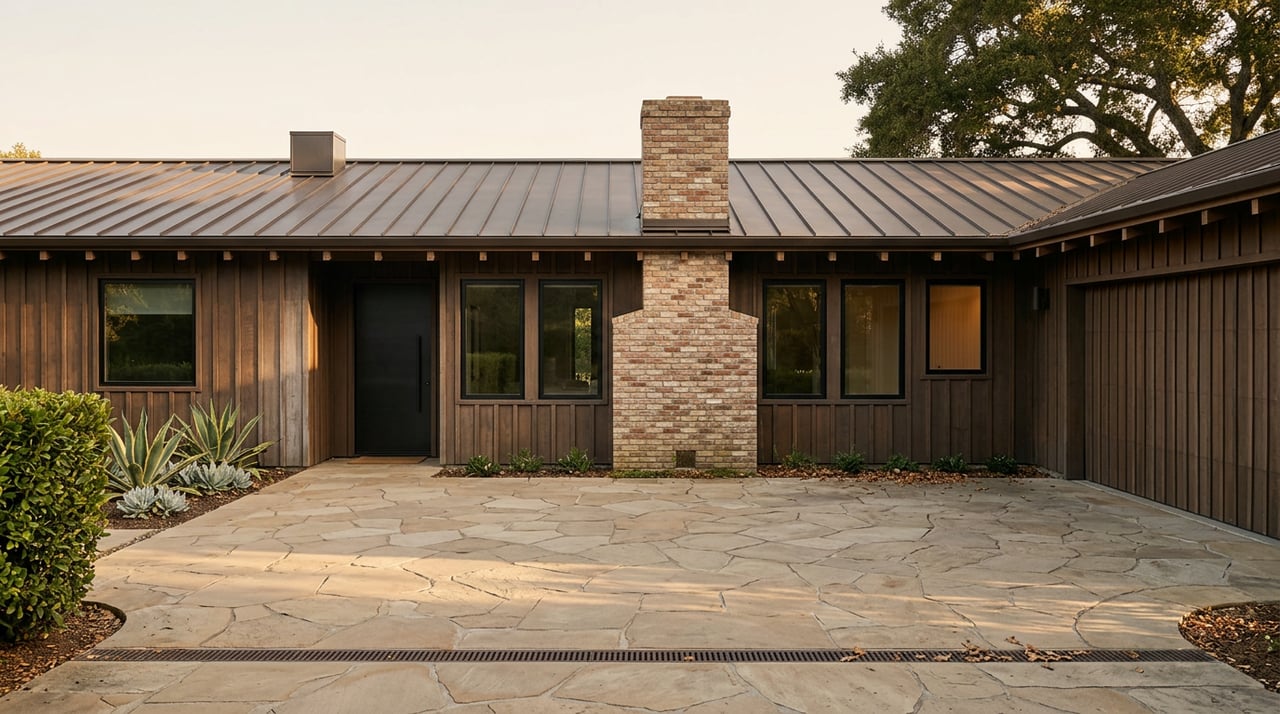
In April 2025, the Los Angeles City Council did something it does rarely for a single builder's work. It voted unanimously to designate a six-unit courtyard apartment building in Valley Glen, the Mellenthin Birdhouse Apartments at 5920 North Buffalo Avenue, as a Historic-Cultural Monument. The vote followed a Cultural Heritage Commission recommendation that February and came after neighbors spent months building the case that this small, whimsical building deserved the city's highest form of protection.
A few miles away, Beeman Park has a larger collection of the same builder's work, but, according to Los Angeles City Planning's list of designated HPOZs, it has no HPOZ designation, preservation plan, or pending nomination. Owners of Mellenthin birdhouse ranches on Beeman Park's inner streets therefore do not have the HPOZ protections described here.
The difference is worth understanding before you buy or sell: a birdhouse roofline alone does not establish a home's history or provide HPOZ protection.
What Los Angeles Just Decided to Protect
William Mellenthin was not a licensed architect. He held a contractor's license starting in 1929 and worked with partners, most notably Leo F. Bachman, on the tract homes that eventually numbered in the thousands across the San Fernando Valley. His signature move, the small dovecote or cupola built into a gable facing the street, started as one option among many and became so identifiable that Angelenos still call any Valley ranch with a birdhouse on the roof "a Mellenthin," whether he built it or one of his imitators did.
The Valley Glen apartments that earned Historic-Cultural Monument status in 2025 are rare precisely because Mellenthin almost never built multi-family housing. The Los Angeles Conservancy, which supported the nomination, has documented the courtyard's shared landscaping and its rent-stabilized units, some occupied by the same tenants for more than two decades. It is a genuinely unusual survivor.
The site had already been approved for a 104-unit development under the city's ED-1 affordable housing program weeks before the City Council voted to landmark it. The Conservancy has said publicly it is still working to make sure the building and its residents get due process.
The Stock Right Down the Street That Isn't
Beeman Park, bordered by Whitsett Avenue to the east and Moorpark Street to the south, is one of the neighborhoods where Mellenthin's single-family work is most concentrated. Los Angeles has designated dozens of neighborhoods as Historic Preservation Overlay Zones since the ordinance passed in 1979, ranging from a few blocks to hundreds of structures. Beeman Park has never gone through that process and has no preservation plan or historic district survey.
The neighborhood's distinctive rooflines remain part of its character, though they are not covered by an HPOZ preservation plan.
How State Law Affects Historic-District Review
If you assumed an HPOZ designation would have solved the problem anyway, recent state law complicates that too. California's Starter Home Revitalization Act, known as SB 1123, now allows multiple new dwelling units to be added to single-family zoned parcels regardless of whether the existing home is a contributing structure in a historic district. Los Angeles City Planning's own guidance on this is direct: state law has begun to override the design guidelines that HPOZ boards used to enforce on ministerial housing applications, and the city is now working through 2026 on a new set of objective design standards to try to preserve some scale and character control within its 35 historic districts. Public comment on that draft closed on July 28, 2026, and the city has said the standards will move into a formal public approval process this fall, so the rules are not yet final.
A home in a designated HPOZ has a board reviewing facade changes and a defined preservation plan, even as state law affects its authority over new unit additions. Beeman Park has no HPOZ board or preservation plan, so its homes do not receive HPOZ review.
What "Documented" Actually Means
None of this means every birdhouse is equally at risk, and it's exactly why attribution has become the thing that separates a routine Valley ranch sale from the kind of result that makes other sellers pay attention. A Mellenthin is not a look. It is a specific builder's output, verifiable through the same paper trail researchers have used to catalog his work: the original tract and permit records, the builder's contractor's license history, and cross-references against known Mellenthin and Bachman-partnered developments across the Valley. Historian Chris Lukather spent years building that record for his book on the subject, and real estate professionals who specialize in these homes now do the same permit-pulling before they ever schedule a photographer.
A house that merely looks the part, one of the many imitators who adopted the birdhouse motif after Mellenthin popularized it in the 1950s, does not carry the same weight in a sale, even if it sits on the same block.
The Premium Is Already Showing Up in Price
Documentation matters when homes are identified and marketed as originals. Mellenthin's houses sold for roughly twenty-five to thirty thousand dollars when they were new. Today, documented examples can sell for seven figures, a shift that has less to do with inflation and more to do with a buyer pool that specifically shops for verified provenance.
That is the pattern worth sitting with. The premium is not attaching to size, lot, or even condition first. It is attaching to proof.
What This Means If You're Buying or Selling in Beeman Park
If you are selling a Mellenthin original here, the paperwork is not a nice-to-have. Pulling the original permit and tract history before you list is what turns "charming 1950s ranch" into a documented piece of Valley architectural history, and the difference shows up in the offers you get.
If you are buying, ask the question directly rather than assuming the birdhouse on the roof settles it. Some of what circulates in Beeman Park is an original Mellenthin. Some of it is a well-executed copy from a builder who borrowed his signature detail. Only one of those carries the collector premium, and neither carries any HPOZ protection if a future owner decides to remodel or redevelop.
If you already own one and have no plans to sell, Beeman Park has no HPOZ preservation plan; the neighborhood's character is shaped block by block by individual owners' choices.
A Few Direct Questions
Does Beeman Park have an HPOZ? No. Los Angeles has designated dozens of neighborhoods as historic districts since 1979, and Beeman Park is not one of them. No preservation plan or pending nomination currently covers the area.
Would an HPOZ fully protect these homes if the neighborhood got one? Not entirely. Under SB 1123, the Starter Home Revitalization Act, state law now allows multiple new dwelling units on single-family lots even inside HPOZs, regardless of whether the existing home is a contributing structure. Los Angeles City Planning is drafting objective design standards through 2026 to try to preserve some local control, but those standards are not finalized.
How do I find out if my house is a documented Mellenthin rather than an imitator? Start with the original building permit and tract records for your address, and compare the builder of record against known Mellenthin developments and his partnership with architect Leo F. Bachman. This is the same research process historians and specialists use before listing a property, and it is worth doing before you assume either way.
If you are trying to figure out what a specific Beeman Park address is actually worth, or whether the birdhouse on your roof is one collectors would recognize, that is exactly the kind of question a local conversation answers faster than a listing search ever will. Bryan Abrams has spent three decades in these blocks and can walk through your home's history with you. Schedule a Studio City market consultation to find out what your address is really carrying.
This article is general information, not legal, tax or financial advice. Consult a qualified professional about your situation.